How Smart Are Hermit Crabs?
Published on: January 7, 2026 | Last Updated: January 7, 2026
Written By: The Crab Guru
Many people assume these tiny shell-wearing pets are simple creatures, but the truth about hermit crab intelligence will surprise you.
After caring for my five hermit crabs for years, I’ve witnessed their remarkable learning abilities firsthand and want to share what I’ve discovered.
Watch how your crab chooses its shell-that decision-making process reveals more than you might think.
We’ll explore their problem-solving skills, memory capabilities, social behaviors, and how you can actually test your crab’s intelligence at home. We’ll also consider whether hermit crabs have personalities, looking at individual behavior traits and temperaments.
What Is Hermit Crab Intelligence? Defining Crustacean Cognition
When we talk about a hermit crab being “smart,” we aren’t comparing them to a dog that can learn tricks. Their intelligence is a different, fascinating kind. It’s about survival and adapting to their world with a simple but effective nervous system. They don’t have a complex brain like ours; instead, they have clusters of nerve cells called ganglia that process information. This decentralized system is perfectly tuned for a creature that needs to find food, avoid predators, and secure a safe home.
From watching my own crabs, I’ve seen how this translates into practical smarts. Here’s a simple comparison based on my observations of Hermes and Apollo versus other common pets.
- Problem-Solving: Hermit crabs excel at physical puzzles, like figuring out how to climb a new decoration or right themselves if they tumble. My crab Hermes is a master of this. A dog might learn a verbal command, but a hermit crab learns the physics of its environment.
- Social Intelligence: They are not social in a cuddly way, but they are highly aware of each other. Zeus, my dominant crab, clearly understands hierarchy and will posture to claim the best food. This is different from a cat’s social structure, which is often more solitary.
- Environmental Mapping: Their ability to learn the layout of their tank is remarkable. They remember where the food dish is, where the best hiding spots are, and the route to the saltwater pool. This spatial memory is their version of a cat knowing exactly where the sunbeam hits the floor at 2 PM.
How Hermit Crabs Learn: Memory and Associative Learning
Hermit crabs are not operating on instinct alone. They learn through experience, and they remember what works. Their primary learning method is called associative learning, where they connect a specific action with a specific outcome. This is the fundamental process that shapes almost all of their adaptable behaviors.
They form memories through a process of trial and error that strengthens the neural pathways for successful actions. For example, when a crab tries a new type of food and finds it delicious and safe, that positive experience gets logged. The same goes for shell selection. When Athena finds a perfectly fitting shell, she remembers the comfort and safety it provides and is less likely to abandon it for a mediocre one.
Research has shown that crustaceans can retain memories for several weeks. Their learning does have limits; you can’t teach them to fetch, and their world is primarily sensory-touch, smell, and sight. But within their realm, they are adept students of their environment.
Evidence of Memory in Daily Hermit Crab Life
You don’t need a scientific study to see hermit crab memory in action. Just watch them for a few days. Their daily routines are proof that they learn and recall information. I see concrete evidence of memory in my tank every single day.
- Navigating Their Home: After an initial exploration period, my crabs move around their 40-gallon tank with clear purpose, taking the most efficient routes to food, water, and hiding spots.
- Recognizing Food Spots: They don’t randomly scavenge. They go directly to the dish or the corner where I typically place treats.
- Shell Assessment: When I introduce new shells, they don’t just grab the first one. They meticulously inspect them, seemingly comparing them to a mental checklist of what makes a good home based on past experience.
- Guarding Behavior: My crab Zeus has a clear memory of being the dominant crab. He consistently returns to and guards the prime food spot, remembering his role and the reward it brings.
Associative Learning and Reinforcement in Hermit Crabs
This is where you can really see their minds at work. Hermit crabs are brilliant at making connections. They learn that a particular cue predicts a particular event, and they adjust their behavior accordingly. Positive reinforcement is a powerful teacher for a hermit crab. If an action leads to something good, like food, they will repeat it.
I use this to my advantage during feeding time. The simple act of opening the tank lid has become a conditioned stimulus. They’ve associated that specific sound and shadow with the arrival of food, and it often triggers a wave of excited movement. Here are some common associations I’ve observed in my own colony.
| Stimulus (The Cue) | Associated Outcome | Observed Behavior |
|---|---|---|
| Sound of the tank lid opening | Feeding time | Crabs become active and move toward the front of the tank. |
| Spray bottle misting sound | Increase in humidity | Crabs often extend their bodies to absorb the moisture. |
| Placement of a specific food dish | Availability of favorite foods (like shrimp) | Rapid gathering at the dish, with more assertive behavior from dominant crabs. |
| The feel of an empty, lightweight shell | An unsuitable home | The shell is quickly inspected and rejected. |
Behaviors That Reveal Hermit Crab Problem-Solving and Smarts
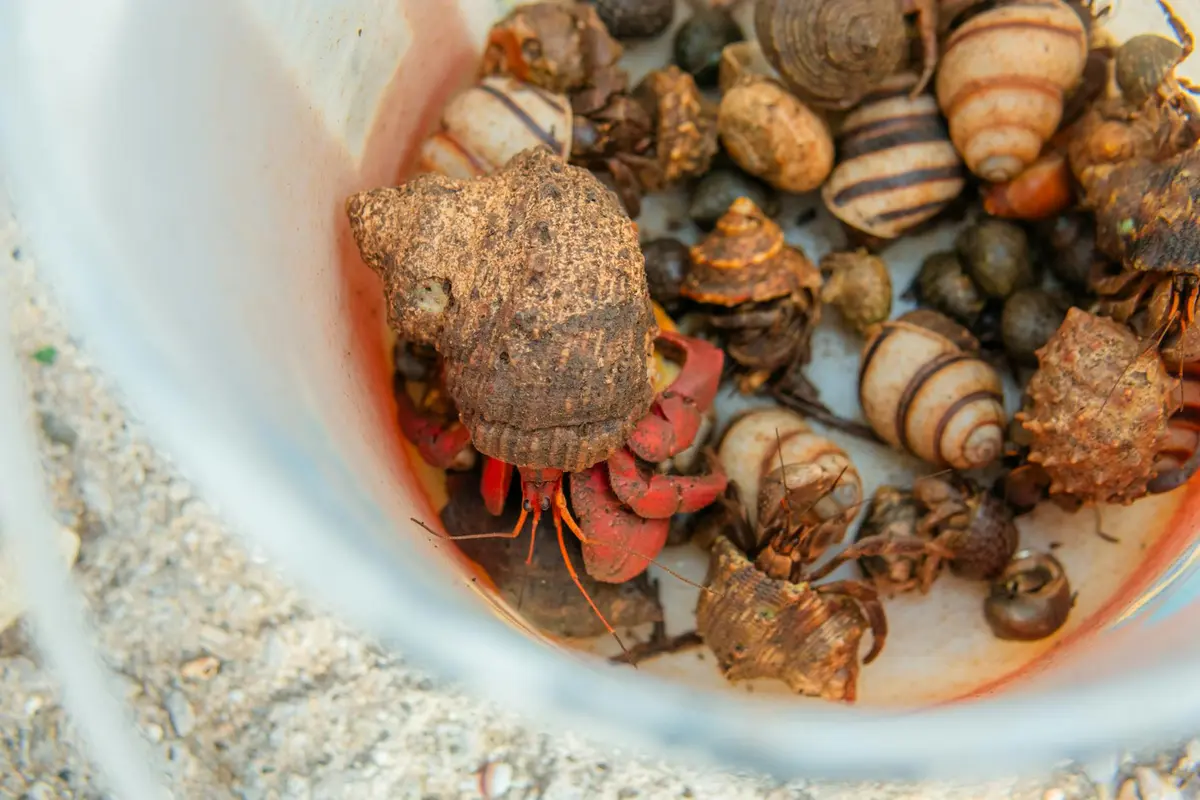
Watching my crabs daily, I’ve seen clear signs of their cognitive abilities. Their actions are far from random; they are deliberate and show a capacity for thought that many people overlook. You just need to know what to look for.
- Exploration and Spatial Mapping: Hermes, my Caribbean crab, doesn’t just wander. He methodically checks every new item I place in the tank, creating a mental map. I’ve seen him find a new route to his favorite basking spot after I rearranged a climbing branch.
- Strategic Shell Swapping: This is a complex decision-making process. I once watched Athena spend over an hour inspecting a new shell, carefully turning it with her claws and antennae, testing its weight and opening before finally deciding it was a worthy upgrade.
- Resourceful Digging: Poseidon’s digging isn’t just for fun. He excavates specific areas to reach the cooler, moist sand underneath to regulate his body temperature and form a perfect molt cave, a clear sign of environmental problem-solving.
- Food Source Guarding: Zeus’s assertive behavior at the food bowl is a calculated social strategy. He learns the feeding schedule and positions himself to control the best resources, demonstrating an understanding of social hierarchy.
Shell Selection and Navigation Strategies
Choosing a new home is one of the most intelligent acts a hermit crab performs. They use a sophisticated combination of touch, sight, and chemical cues to assess a shell’s suitability—it’s a process that’s as fascinating as it is crucial for their survival. My crab Apollo is a true shell connoisseur, and his process is fascinating to watch, especially when compared to the detailed selection behavior discussed in The Science Behind Hermit Crab Shell Selection.
Here are the steps I’ve observed:
- Initial Inspection: They use their eyes and antennae to gauge the shell’s size and shape from a distance.
- Tactile Examination: Their claws meticulously explore the shell’s interior, checking for cracks, smoothness, and the size of the aperture.
- Weight and Balance Test: The crab will lift and maneuver the shell, assessing if it’s too heavy to carry comfortably.
- The Ultimate Fit Check: They quickly back into the shell, using their abdomen to feel if the fit is snug and secure. If it’s not perfect, the search continues.
Apollo will sometimes collect and hoard a few “backup” shells in a corner, a behavior that shows remarkable foresight and planning for future growth.
Social Learning and Imitation Among Hermit Crabs
While hermit crabs aren’t pack animals, they absolutely learn from each other’s presence. I’ve seen clear evidence of behavioral flexibility and imitation in my own tank, especially around new resources. In a tank with several crabs, these social cues shape how they explore and distribute space. Managing multiple crabs in one tank makes understanding their hermit crab social dynamics essential.
When I introduced a new type of food, Athena was hesitant. She watched Zeus approach and eat it without issue. Only after observing him for several minutes did she feel safe enough to try it herself. This is a form of social learning called stimulus enhancement. One crab doesn’t “teach” another, but its actions draw attention to a new possibility. If one crab discovers a new hiding spot or a better way to climb a decoration, others will often investigate and adopt the same behavior. Their social structure is a low-key classroom of trial and observation.
Enhancing Hermit Crab Intelligence Through Care and Enrichment
A bored crab is an under-stimulated crab. Providing a complex habitat isn’t a luxury; it’s a fundamental aspect of ethical pet ownership that directly supports their cognitive development. A rich environment encourages natural behaviors and problem-solving, making for a happier, healthier, and smarter crab.
Follow these steps to create a stimulating home:
- Maximize Vertical Space: Hermit crabs are natural climbers. Use safe woods, cholla wood, and reptile hammocks to create a multi-level landscape.
- Offer a Variety of Substrates: Mix play sand with coconut fiber. Add a deep area for digging and a moist moss pit. Different textures provide different sensory experiences.
- Rotate Toys and Challenges: Introduce new, safe items weekly. This could be a new piece of driftwood, a shallow dish with pebbles to walk over, or a cuttlebone to explore and nibble.
- Provide Hiding Places: Multiple hides, like half-coconut shells or reptile caves, offer security and choice, allowing them to control their environment.
- Vary the Diet: Present food in different ways-sometimes in a dish, sometimes scattered for foraging, sometimes tucked inside a puzzle made of a walnut shell.
DIY Enrichment Ideas for Smarter Hermit Crabs
You don’t need to spend a lot of money to create a smart habitat. Some of the best enrichment comes from simple, safe items you likely already have at home. My crab Hermes goes wild for these DIY projects.
- The Lego Climbing Wall: Use clean, classic Lego bricks to build a customizable and easily sanitized climbing structure against the tank glass.
- Foraging Balls: Take a clean, plastic ball with holes (like a cat toy), fill it with dried shrimp or other treats, and watch them roll it around to get the food.
- Natural Obstacle Course: Arrange smooth stones, different-sized shells, and pieces of cholla wood to create a path they must navigate to reach a food reward.
- Shell Shop: Always keep a curated selection of 3-5 empty, sterilized shells of various sizes and shapes available. This encourages natural shell inspection behavior.
How Ontogeny Affects Learning in Growing Hermit Crabs
A crab’s capacity to learn and solve problems changes dramatically as it grows and molts. Watching my crabs from juvenile to adult stages has shown me that their intelligence is not static; it develops with experience.
| Life Stage | Typical Behaviors & Learning Capacity | Example from My Tank |
|---|---|---|
| Juvenile (Small) | High exploration, rapid habituation to new objects, basic shell selection. | Poseidon, at a smaller size, was endlessly curious but often clumsy in his explorations. |
| Sub-Adult (Medium) | Refined problem-solving, complex shell assessment, begins to understand social cues. | Hermes now expertly navigates the most complex climbing structures and carefully weighs shell options. |
| Adult (Large) | Strategic behavior, established social hierarchy, efficient navigation, and sophisticated resource management. | Zeus and Athena show clear memory of tank layout and have established preferred territories and routines. |
Each successful molt seems to bring a new level of confidence and cognitive ability. Providing consistent enrichment throughout their lives is key to supporting this beautiful developmental journey.
Debunking Myths: Separating Fact from Fiction in Hermit Crab Cognition
Many people see a hermit crab’s small size and simple exterior and assume there’s not much going on inside. I’ve found this assumption to be completely wrong after years of observing my own crabs, from the bold explorer Hermes to the quiet observer Athena. Let’s clear up some of the most common misunderstandings about what’s happening inside those tiny shells.
Myth vs. Fact: The Real Story on Hermit Crab Smarts
-
Myth: Hermit crabs are simple creatures operating only on instinct.
Fact: They are capable of complex learning and memory. I’ve watched Apollo learn the exact time I typically feed them and wait by the food bowl in anticipation. This isn’t a random instinct; it’s a learned association between a specific time and a rewarding outcome. Research supports this, showing they can remember rewarding food locations and navigate complex environments.
-
Myth: Hermit crabs don’t feel pain or stress.
Fact: They absolutely exhibit signs of both distress and contentment. A crab constantly hiding or trying to escape the tank is stressed. One of my crabs, Zeus, will aggressively guard a prized piece of food, showing clear possession behavior. Observing their body language and activity levels provides a clear window into their emotional state. Learning to read these cues is essential for properly handling your hermit crab. With this understanding, you can adjust handling and tank setup to minimize stress.
-
Myth: Their shell choice is random.
Fact: Shell selection is a deeply cognitive process. They meticulously inspect new shells, gauging weight, size, and internal architecture with their claws and antennae. I’ve seen Poseidon try on three different shells in one night before settling on the perfect one, a clear demonstration of assessment and choice. A poor shell choice can lead to vulnerability and stress, so this decision is critical.
-
Myth: Hermit crabs are not social and don’t recognize tank mates.
Fact: They live in large colonies in the wild and have a social hierarchy. In my tank, the crabs know each other. The smaller crabs will often move away when Zeus, my dominant crab, approaches a prime basking spot. This avoidance isn’t accidental; it’s a learned social dynamic to prevent conflict. They communicate through gentle antennae taps and physical positioning.
Watching my crabs solve the simple puzzle of a piece of food stuck under a decoration, or seeing Athena methodically explore a new climbing branch, confirms their ability to problem-solve. Their intelligence is not like a dog’s or a parrot’s, but it is a specialized and effective intelligence for the world they live in. Dismissing them as simple is a disservice to their complex and fascinating nature.
FAQs
Can hermit crabs recognize their owners?
While hermit crabs may not recognize owners in the same way mammals do, they can learn to associate your presence with positive events like feeding. Over time, they might become less skittish and more active when you approach, showing they’ve formed a connection. Understanding their social needs is key to providing the right environment for them.
How long do hermit crabs remember learned behaviors?
Hermit crabs can retain memories for several weeks, especially for rewarding experiences like finding food or safe shells. This memory duration helps them navigate their environment efficiently and avoid repeating past mistakes, particularly when it comes to common habitat mistakes.
What are signs of a bored or under-stimulated hermit crab?
A bored hermit crab may exhibit repetitive behaviors, like constant climbing on the tank walls or lack of activity. Providing enrichment, such as new climbing structures or foraging toys, can encourage natural behaviors and mental engagement.
Recognizing Their Keen Minds
Your hermit crabs are far more perceptive and capable of learning than many people realize. By observing their unique personalities and providing a stimulating habitat with puzzles and varied foods, you directly nurture their natural curiosity and problem-solving skills. Pay close attention, and you will be consistently surprised by the clever behaviors these small, complex creatures display, especially when engaged with toys and enrichment activities.
Further Reading & Sources
- The Unexpected Intelligence of Hermit Crabs – Sarah McCarthy’s Blog
- Hermit crabs’ intelligence? – HCA: Hermit Crab Association
- r/hermitcrabs on Reddit: Are hermitcrabs intelligent and have feelings to owner?
The Crab Central is your ultimate resource for hermit crab enthusiasts, providing expert advice and practical tips to ensure the health and happiness of your shelled companions. With years of experience in crustacean care, we are dedicated to offering accurate, up-to-date information to support your hermit crab journey. Our mission is to foster a community of responsible hermit crab owners who are passionate about the well-being of these fascinating creatures.
Understanding Hermit Crab Behavior